EuroQCS-Poland will provide a digital, gate-based quantum computer, based on trapped-ions offering 20-plus physical qubits.
Quantum
computer
This quantum computer will primarily target research and innovation and will be available to a wide range of European end-users, spanning from the scientific community to industry and the public sector. It will support the development of a wide range of applications with industrial, scientific and societal relevance for Europe and adding new capabilities to the European supercomputing infrastructure. The new quantum computer will be integrated with a classical supercomputing system to enhance
hybrid quantum-classical computing approaches. Consequently, new hybrid quantum-classical use cases and benchmarks will be supported, including but not limited to quantum optimization, quantum chemistry, quantum material sciences and quantum machine learning. The new system on the basis of trapped-ions will also provide several unique features that will make it attractive for end-users and applications like high fidelity qubits, long coherence times, universal quantum gates and all-to-all connectivity support.
PSNC leads the EuroQCS-Poland consortium, which consists of two additional Polish partners, the Center for Theoretical Physics Polish Academy of Science and Creotech Instruments S.A, and one academic partner from Latvia, the University of Latvia. EuroQCS-Poland is co-funded with a total acquisition cost of EUR 12.28 million. The EuroHPC JU will fund 50% of the costs and the remaining 50% will be funded by the Ministry of Digital Affairs of Poland. AQT (Alpine Quantum Technologies GmbH in Innsbruck, Austria) has been selected following a call for tender launched in October 2023.
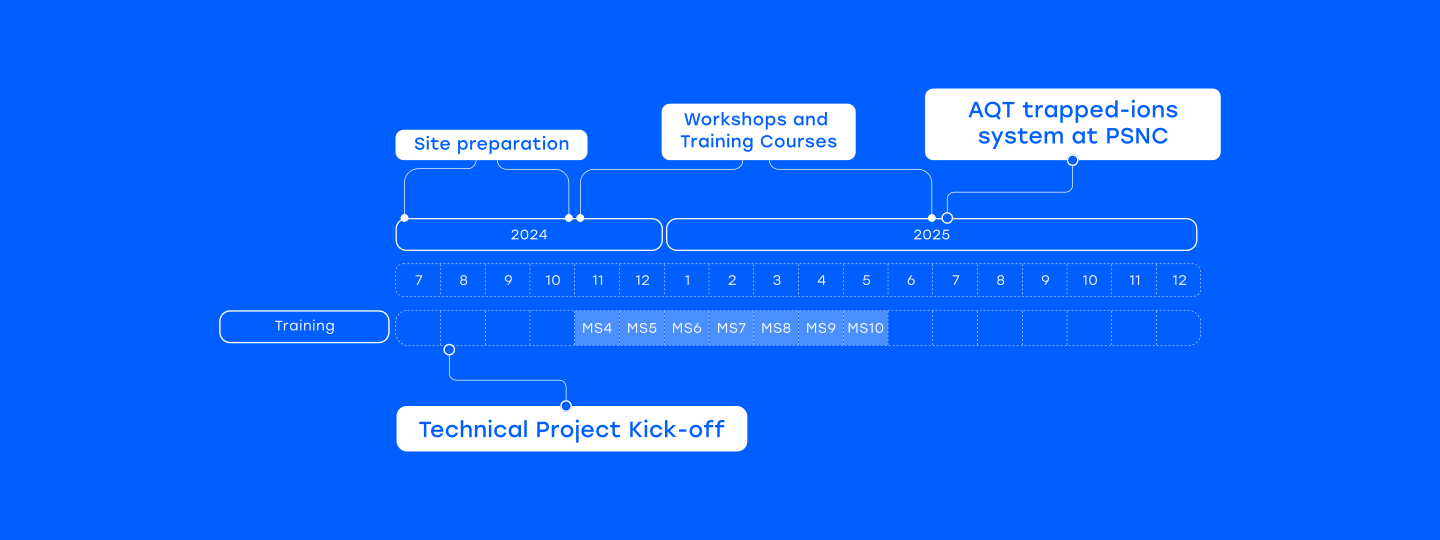
Workshops
MS4
Workshop on “Basics of ion-trap quantum computing”
When:
November 28, 2024
Format:
Virtual
MS5
Workshop on “Operating the QC and running circuits from a QC operator's viewpoint”
MS6
Workshop on “Integration with HPC, interfaces, and software architecture”
When:
January 2025
Format:
Virtual
MS7
Workshop on “IT infrastructure requirements and setup for the deployment of an on-premise QC”
MS8
Workshop on “IT infrastructure requirements and setup for network connectivity between QC and HPC”
MS9
Workshop on “Environmental monitoring and performance indicators”
MS10
Workshop on “Benchmarking and applications on ion-based QCs”
When:
May 2025
Format:
Virtual
Form
If you’d like to attend one of the open workshops, please register
About the trapped ion quantum technology
Photonic quantum computers can be applied to many areas in the near future, including those related to medicine, biology or logistics.
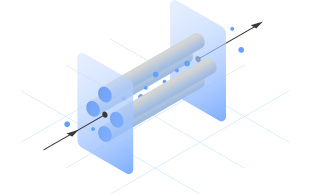
These computers use precisely directed laser pulses to manipulate and change the quantum information encoded in ions. To achieve precision, it's essential to focus the laser beam on a specific ion or group of ions. AQT quantum computer is characterized by its proven architecture, as well as its modularity, and expandability. Developed and validated in collaboration with the University of
Innsbruck, AQT’s system fits into two 19-inch racks commonly used in data centers. Additionally, the system operates at room temperature and consumes less than two kilowatts of electrical power eliminating the need for special cooling, water, or extensive energy infrastructure.
Benefits
In comparison to other quantum technologies, ion traps offer several benefits.
Ion traps can operate at room temperature, which greatly facilitates their use and integration with existing computer infrastructure.
They can be combined into hybrid architectures, which opens up the possibility of using different quantum platforms in one system.
They are scalable, which means they can be expanded by adding more ions to the system and increasing its computational power.
They do not require advanced cooling or other special environmental conditions. This makes them flexible in terms of integration with other technologies.
Additionally, ion trap systems also offer a dense network of connections between individual qubits. Each ion in the trap can be connected to other ions, enabling efficient information exchange and the execution of complex quantum operations. This dense network of connections provides greater flexibility and potential for conducting advanced quantum
computations. As a result, ion trap systems are capable of generating large entangled states and utilizing complex quantum algorithms to solve intricate problems. This is one of the main strengths of this technology and makes ion traps an attractive choice for the development of quantum computing systems.
The nearfuture
In the near future, it is expected that ion traps will be used for various applications such as process optimization, machine learning, and risk analysis.
Their computational capabilities and the stability of quantum states make them a promising technology in the field of quantum data processing.